
Frequently Asked Questions about making homemade jam, gelling agents and erythritol
Category 1
Basics & Definitions
What exactly is a gelling agent, and how does it differ from conventional jam sugar?
Why should I use a 4:1 gelling agent instead of 1:1 or 2:1?
The 4:1 ratio stands for four parts fruit and one part gelling agent. This is the ideal ratio for anyone who loves the pure, authentic taste of fruit. It allows for the highest possible fruit content while simultaneously reducing the amount of added calories to an absolute minimum.
Is gelling agent the same as jam sugar?
No. A gelling agent (such as the pectin used in our product) is merely the plant-based component responsible for the setting process. Jam sugar, on the other hand, is a ready-to-use product that consists largely of granulated sugar. A gelling aid is the perfect tool to bind fruit spreads precisely without having to rely on granulated sugar.
How much gelling agent do I need for 1 kg of fruit?
Our 4:1 gelling agent is highly efficient. One pouch (330 g) is sufficient for 1.3 to 1.5 kg of prepared fruit. For exactly 1 kg of fruit, you will need approximately 220 to 250 g of our gelling agent.
Category 2
Troubleshooting & Application
What can I do if my jam remains too runny after cooking?
If the mixture is still too thin after the cooking time, this may be due to the low natural acidity of the fruit (e.g., with very sweet strawberries). A squeeze of lemon juice can often work wonders here. Additionally, let the mixture come to a rolling boil for another 2–3 minutes and then perform another gel test.
How can I thicken jam that has already been jarred?
Don’t worry, a runny spread can still be saved: Pour the contents of the jars back into a pot, add a small amount of fresh gelling agent (and some lemon juice if needed), and bring everything to a rolling boil again for at least 5 minutes. Once you’ve achieved a successful gel test, you can pour the mixture into freshly sterilized jars.
How do I perform a gel test correctly?
Place a teaspoon of the hot fruit mixture onto a cold plate (some swear by using a plate chilled in the refrigerator). Wait for about one to two minutes. If the mixture sets and no longer runs when the plate is tilted, your spread has reached the perfect consistency.
Why is finely pureeing the fruit so important for the gelling result?
Pectin needs contact with the fruit cells to build a stable network. By pureeing the fruit finely, you increase the surface area and release the natural binding power of the fruit. This ensures a more consistent, reliable set and prevents crystallization.

Category 3
Conscious Nutrition & Calories
How many calories do I save with an erythritol-based gelling agent?
The difference is enormous: While conventional jam sugar contains approx. 390 kcal per 100 g and gelling agents with xylitol (birch sugar) still come in at approx. 240 kcal, our erythritol-based gelling agent has only 10 kcal per 100 g. That is roughly 95% fewer calories compared to classic jam sugar!
Is the gelling agent suitable for a sugar-reduced diet?
Yes, absolutely. Since erythritol does not affect blood sugar levels like granulated sugar does, our gelling agent is perfectly suited for a sugar-reduced and carb-conscious lifestyle. This allows you to enjoy fruity spreads completely guilt-free.
In what way is the use of erythritol tooth-friendly?
Unlike granulated sugar, erythritol does not serve as a food source for cavity-causing bacteria in the mouth. Since no acids are produced that attack tooth enamel, consuming foods sweetened with erythritol contributes to the maintenance of tooth mineralization.
Category 4
Ingredients & Vegan Lifestyle
What is the difference between pectin, agar-agar, and gelatin?
Pectin is extracted from plant peels (e.g., apples or citrus fruits) and is the tried-and-tested classic for fruit spreads. Gelatin is of animal origin and therefore not vegan. Agar-agar is derived from algae, but requires very precise dosing and a different cooking time to remain stable. We rely on high-quality, purely plant-based pectin.
Is the gelling agent vegan and free from animal-derived ingredients?
Yes, our gelling agent is 100% vegan. We use exclusively plant-based pectin as the gelling agent and are completely free from any animal-derived components.
Category 5
Storage & Shelf Life
What is the shelf life of homemade fruit spread without added sugar?
Unopened and stored in a cool, dark place, your spread will last for several months. However, since the product does not rely on high sugar content for preservation, absolute hygiene during the jarring process (using sterilized jars!) is crucial for maximum shelf life. Once opened, jars should always be kept in the refrigerator and consumed promptly.
Do I really need to turn the jars upside down after filling?
Yes, we explicitly recommend this. Fill the hot fruit spread into sterilized jars, seal them tightly, and turn them upside down for at least 10 minutes. This sterilizes the lid area using the heat of the mixture and supports the formation of a protective vacuum as it cools.
A tip for shelf life: By turning the jars upside down for about 5–10 minutes, the residual heat optimally sterilizes the lid. As the jar cools down afterwards, the air inside contracts—creating the protective vacuum that securely seals your spread.
Note: With modern twist-off lids, turning them upside down is often no longer strictly necessary, as high-quality seals ensure a secure closure even when upright. This also prevents the hot fruit mixture from staying in contact with the inside of the lid for too long and keeps the thread clean for optimal shelf life.
How should I best store my jam to keep the color bright red?
Light is the enemy of natural fruit colors. Therefore, be sure to store your supplies in a dark place (e.g., in a pantry or cupboard). For the best color stability and freshness, we also recommend storage in the refrigerator – this applies especially to jars that have already been opened.
From what age can children eat fruit spreads with erythritol?
Erythritol-based fruit spreads are suitable for children from one year of age. Since the gut flora of infants under 12 months is still developing, their digestive system can react sensitively to sweeteners at this early stage.
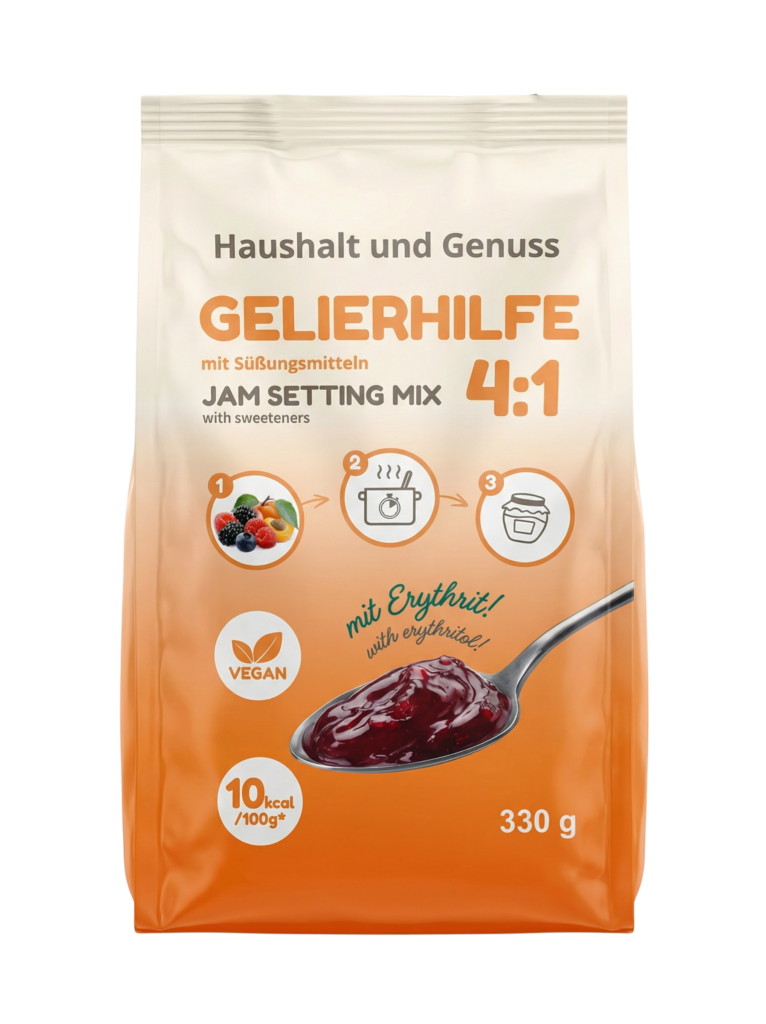
Jam-Setting-Mix 4:1
330 g · Net | Perfect for 1.3 – 1.5 kg fruit
Our product is already available at the listed shops and marketplaces. If you have any questions, feel free to contact us!
